






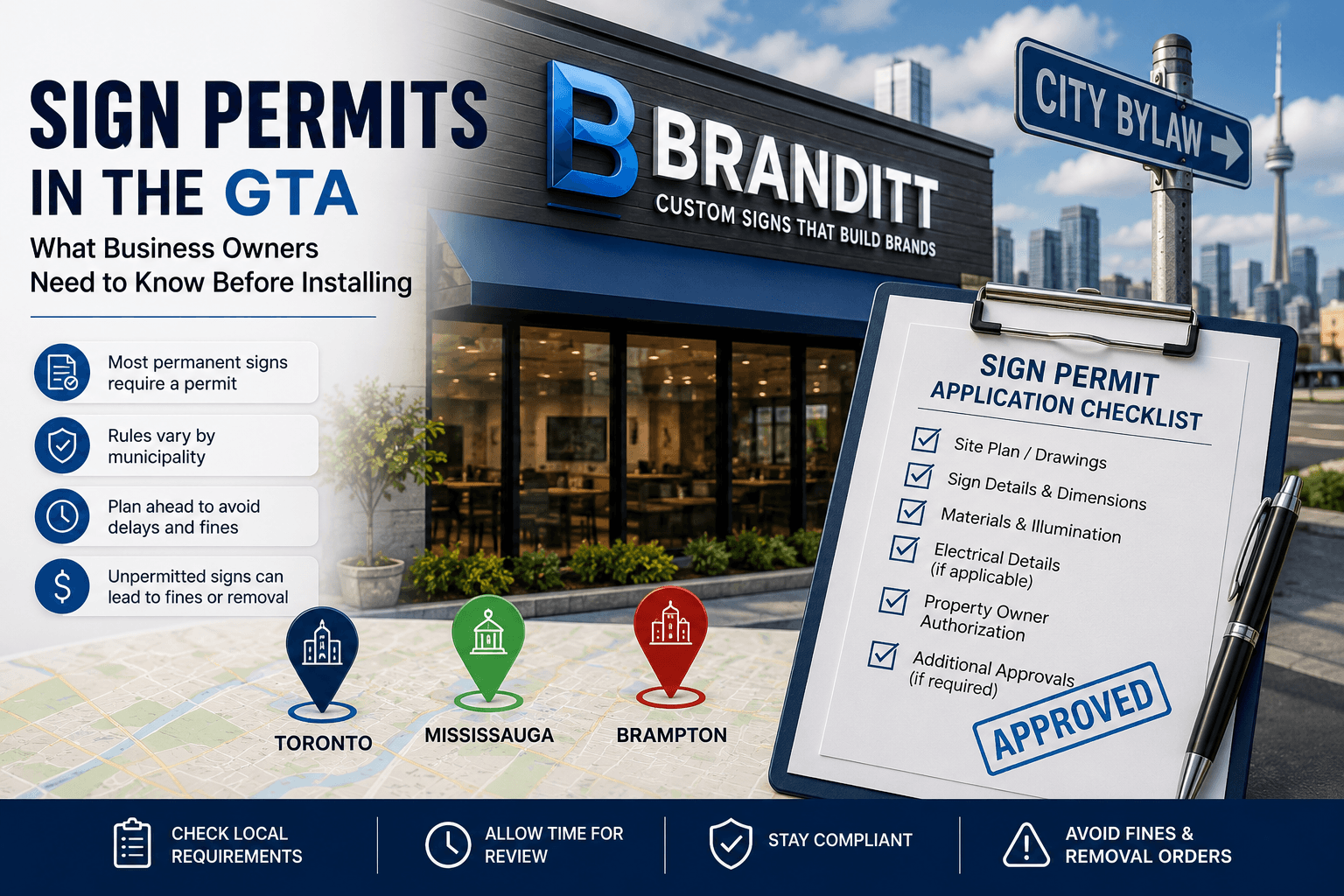
Sign Permits in the GTA: What Business Owners Need to Know Before Installing
Most permanent business signs installed in the Greater Toronto Area require a sign permit from the local municipality, separate from any building permit the property itself may need. Every GTA city sets its own sign bylaw, so requirements, exemptions, and review timelines vary from one municipality to the next. Toronto regulates signs under Chapter 694 of its Municipal Code and reviews most applications in about ten business days, while Mississauga runs permanent sign applications through a pre-screen and a full review that together typically take two to three weeks. Installing a sign without the required permit can result in fines and, in some cases, the city ordering the sign removed at the owner's expense.
Key Takeaways
- Sign bylaws are set at the municipal level in Ontario, not provincially, so a rule that applies in Toronto may not apply the same way in Mississauga, Brampton, or Burlington.
- Most signs mounted to a building or installed in the ground need a sign permit, even signs that do not light up.
- Some sign types, such as certain window signs or small temporary signs, are exempt in some cities and not in others, which is one of the most common sources of confusion for business owners opening a new location.
- Illuminated signs typically require an additional electrical permit alongside the sign permit itself.
- Properties in a Heritage Conservation District, near a highway, or within a conservation authority's jurisdiction often need extra approvals that add time to the process.
- Planning the permit timeline into a store opening or rebrand schedule, rather than treating it as a last step, is the single biggest factor in avoiding delays.
Why Sign Permits Exist
A sign permit process might feel like paperwork standing between a business and its storefront, but the review serves two practical purposes. First, it confirms the sign is structurally sound and will not become a hazard to pedestrians or vehicles, particularly for larger illuminated signs, pylon signs, and anything projecting over a public sidewalk. Second, it keeps signage within limits the municipality has set for a given area, covering things like maximum size relative to the building facade, placement, and how many signs one property can display. The City of Toronto's own guidance frames this directly: sign and building permits allow staff to confirm proposed construction meets the Ontario Building Code and complies with the local Sign By-law, which keeps the public safe and limits the impact on surrounding properties.
For a business owner, the practical takeaway is that permit review is not optional friction. It is the process that determines whether a sign design can legally be built as drawn, and skipping it puts the investment in the sign itself at risk.
Do You Need a Permit? The General Rule
Across nearly every GTA municipality, the same general rule applies: if a sign is mounted to a building or installed into the ground, it needs a permit, whether or not it is illuminated. Toronto's building division states this plainly, noting that any time a sign is installed on a building or into the ground, a sign and building permit is required.
Where cities differ is in the exemptions. In Toronto, window signs, topiary signs, and painted wall signs do not require a full Building Permit but still require a Sign Permit. In other GTA cities, window graphics may fall outside the bylaw entirely, or be treated differently depending on how much of the window they cover. This inconsistency is one of the most common reasons businesses with locations in more than one GTA city end up needing separate research, and sometimes separate permits, for what looks like the same sign installed twice.
Temporary and portable signs, such as A-frame sidewalk signs or short-term promotional signage, almost always need their own permit type, usually with a stricter time limit. Toronto, for example, allows mobile signs for a maximum of thirty days per permit, with a capped number of permits per business location each year.
How the Process Differs Across the GTA
Toronto
Toronto regulates signage under its Sign By-law, administered through Chapter 694 of the Toronto Municipal Code. Signs are classified as either First Party, identifying a business or service located on the property, or Third Party, advertising something unrelated to the premises. The standard review timeline for a Sign Permit is about ten business days. For businesses that need faster turnaround, Toronto offers a Fast Track option with a two-day review, but only for applications that include engineer-stamped drawings and have no bylaw deficiencies or outstanding approvals such as heritage or conservation authority sign-off. The City recommends starting with a Preliminary Project Review for any sign that is likely to need a variance from the bylaw, since this identifies problems before a full application is submitted rather than after.
Mississauga
Mississauga regulates signage under its own Sign By-law, in place since 2002 and administered by the Planning and Building Department. Permanent sign applications go through a pre-screen review first, which typically takes three to five business days and checks that the minimum submission requirements are met. Once an application clears pre-screen and required fees are paid, it moves to a full review against the building code and sign bylaw, which the City indicates generally takes about two weeks for a complete application. As of 2015, Mississauga moved to fully electronic submission for permanent sign permits, so paper or in-person applications are no longer accepted for this permit type.
Other GTA Municipalities
Brampton, Vaughan, Markham, Oakville, Burlington, and the rest of the GTA's municipalities each maintain their own sign bylaw, and the details, not just the fees, can differ meaningfully. Some cities require a stamped engineering drawing for a wider range of sign types than others, and coverage of window signage in particular is inconsistent from one bylaw to the next. The practical implication for any business operating in more than one GTA city is that a sign approved in one location cannot be assumed to comply automatically in another, even if the design is identical.
What Happens If You Skip the Permit
Installing a sign without the required permit is treated as a bylaw violation in every GTA municipality that regulates signage, and enforcement is active rather than theoretical. In Toronto, an unpermitted sign can result in a fine, a charge to appear in court, and removal of the sign at the property owner's expense, with additional administrative fees applied when a permit application is filed after installation rather than before. In Mississauga, portable and permanent signs installed without the required approval can be removed by the City if deemed unsafe or non-compliant, with fines applying on top of removal.
Beyond the direct penalty, the more costly outcome for most businesses is timing. A sign built and installed before permit approval, only to be found non-compliant, often has to be modified or replaced entirely, which erases any time saved by skipping the process in the first place.
Special Approvals That Can Add Time
A handful of situations commonly extend the standard permit timeline beyond what a business might expect:
- Heritage Conservation Districts. Properties within a designated heritage area typically need heritage approval in addition to standard sign permit review, which can add meaningful time depending on the municipality.
- Highway and conservation authority proximity. Signs near provincial highways may require Ministry of Transportation approval, and properties near rivers, ravines, or other regulated features may need sign-off from the local conservation authority, such as the Toronto and Region Conservation Authority.
- Illuminated and electrical signage. Any sign with electrical components generally needs an electrical permit in addition to the sign permit, handled through the Electrical Safety Authority rather than the municipality itself.
- Structural or large-format signs. Pylon signs, monument signs, and large projecting signs typically require engineering drawings with a Professional Engineer's stamp confirming the structure meets the Ontario Building Code.
Building any of these into the project timeline from the start, rather than discovering them mid-application, is the most reliable way to avoid a stalled sign installation.
How Branditt Handles the Permit Process
Because GTA sign bylaws vary by city and by sign type, Branditt works through the classification and drawing requirements for each project before production begins, whether that is anoutdoor sign like a pylon or channel letter installation, or interior signage that falls outside municipal permitting altogether. For businesses opening in more than one GTA location, that groundwork is done separately for each city rather than assumed to carry over, which is where most permit delays actually originate.
Frequently Asked Questions
Do all business signs in the GTA need a permit? Most permanent signs mounted to a building or installed in the ground need a permit in nearly every GTA municipality. Exemptions exist for specific sign types, such as certain window signs or small temporary signage, but these exemptions differ by city, so the same sign type may need a permit in one municipality and not another.
How long does a sign permit take to approve in the GTA? Timelines vary by city. Toronto's standard review is about ten business days, with a two-day Fast Track option for applications that meet stricter requirements. Mississauga's permanent sign process typically takes three to five business days for pre-screen plus about two weeks for full review when the application is complete. Other municipalities set their own timelines, so it is worth confirming directly with the local building or planning department.
Does a sign permit cover electrical work for an illuminated sign? No. An illuminated sign generally needs a separate electrical permit through the Electrical Safety Authority in addition to the municipal sign permit.
What happens if a sign is installed without a permit? Municipalities can issue fines, require the sign to be removed at the owner's expense, and in some cases apply additional administrative fees for permits filed after installation. Enforcement is active across GTA cities, so this is not a low-risk shortcut.
Do I need a new permit if I am opening the same business in a different GTA city? Yes, in almost every case. Sign bylaws are set municipally in Ontario, so an approved sign design in one city is not automatically compliant in another, even when the sign itself is identical.
Plan Your Sign Installation With the Permit Timeline in Mind
Whether you are opening a new location or replacing an aging storefront sign, the permit process works best when it is planned alongside the design rather than after it. Exploreoutdoor signage options built to GTA bylaw and Ontario Building Code requirements, or reach out at hello@branditt.ca to start the classification and drawing process for your project.